


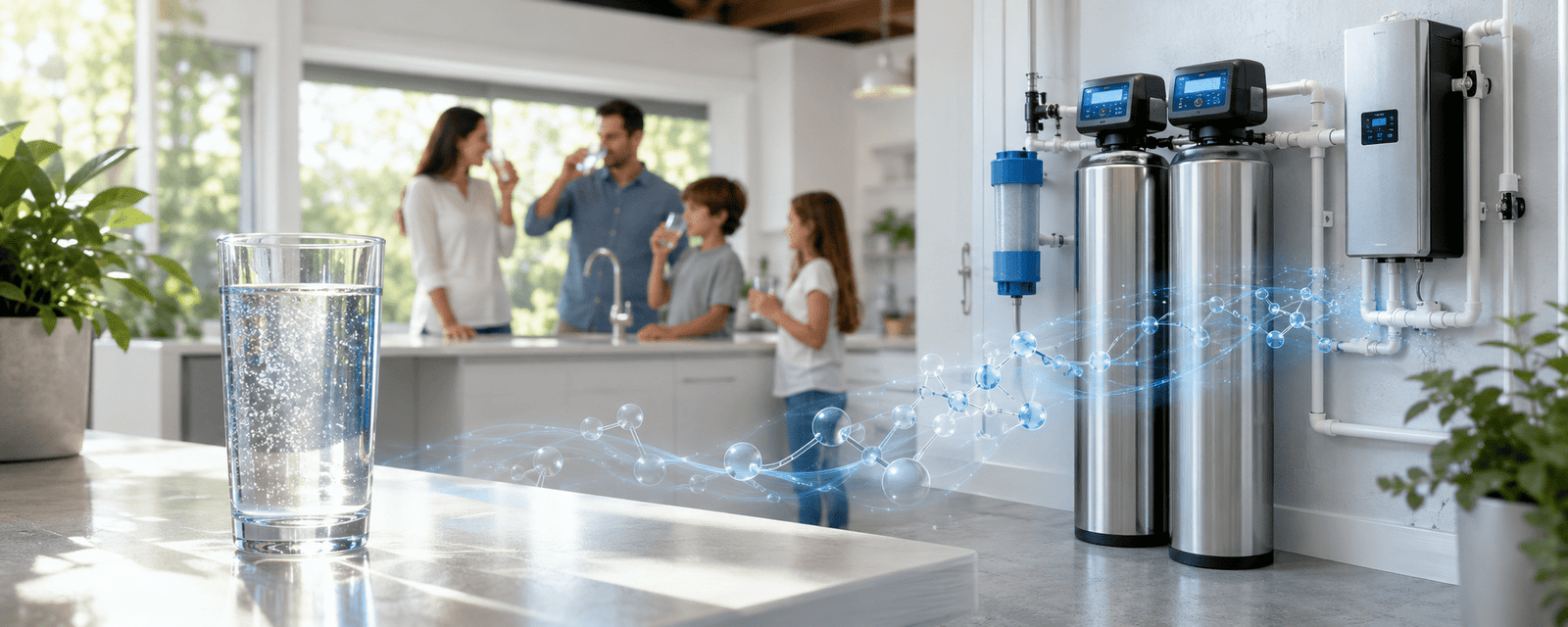
Per- and polyfluoroalkyl substances (PFAS) “forever chemicals” are dangerous, long-lasting chemicals increasingly found in municipal and well water supplies across the United States. Removing these harmful contaminants from your drinking and bathing water requires the right purification setup, often coming down to a choice between whole house filtration systems and point-of-use reverse osmosis (RO) units, And US homeowners often gets confused between whole house filter vs RO for PFAS. This guide explores the effectiveness of both methods, helping you decide whether whole house carbon filters or RO systems make the most sense for your family’s health and home wellness goals.
Key Takeaways
- PFAS require specialized filtration: Standard refrigerator filters cannot remove these persistent chemicals; you need specifically designed carbon filtration or reverse osmosis.
- Whole house systems protect every tap: A whole home solution provides cleaner water at every tap, protecting your skin, hair, and respiratory system from aerosolized contaminants during showers.
- Reverse osmosis offers maximum purity: RO systems are highly effective at stripping out nearly all dissolved solids, making them ideal for dedicated drinking water faucets.
- Carbon filters can remove PFAS: High-quality, catalytic granular activated carbon (GAC) filters are proven to effectively reduce PFAS levels when sized and maintained correctly.
- Hybrid systems offer the best protection: Combining a whole house carbon filter with a point-of-use RO system ensures comprehensive home protection and the purest possible drinking water.
Why do PFAS chemicals require specific water filtration?
PFAS require specific water filtration methods. Because their unique chemical structure makes them resistant to breaking down in water, earning them the nickname “forever chemicals.” According to the Environmental Protection Agency (EPA), long-term exposure to these compounds is linked to various health issues. Because the carbon-fluorine bond in PFAS is incredibly strong, basic sediment filters or cheap pitcher filters simply let the chemicals pass right through. Removing them requires advanced purification systems that use physical exclusion (like an RO membrane) or chemical adsorption (like specialized carbon media) to effectively trap and remove the contaminants from your water supply.
How effective whole house filtration for PFAS removal?
Whole house filtration systems can be highly effective for PFAS removal, but their success depends heavily on the type of filter media used, the system’s flow rate, and how consistently the filters are maintained.
Not all whole house filters are created equal — a standard sediment or basic carbon block filter will do little to reduce PFAS concentrations. However, systems equipped with high-quality catalytic granular activated carbon (GAC) or specialized PFAS-targeted media have demonstrated impressive reduction rates in independent laboratory testing.
EPA and NSF Standards
The EPA and NSF International have both validated that GAC-based whole house systems. When properly sized, can reduce PFAS levels by 70–99% depending on the specific compounds present. The key advantage of a whole house approach is comprehensive coverage — every tap, shower, bathtub, and appliance in your home receives filtered water, reducing total body exposure from multiple pathways simultaneously.
What types of whole house filters work best against PFAS?
When evaluating whole house filtration for PFAS removal, the filter media is the most critical variable. Here are the primary options:
Catalytic Granular Activated Carbon (GAC):
This is the most widely recommended media for whole house PFAS reduction. Catalytic GAC is more porous and reactive than standard activated carbon, providing greater surface area for adsorption. It is especially effective against longer-chain PFAS compounds like PFOA and PFOS, which are among the most regulated contaminants.
Ion Exchange Resins:
Some whole house systems incorporate anion exchange resins specifically designed to target PFAS. These resins bind to the negatively charged PFAS molecules and pull them out of the water stream. Ion exchange is particularly effective against short-chain PFAS variants that activated carbon sometimes struggles to capture.
Hybrid Multi-Stage Systems:
The most advanced whole house filters combine GAC with ion exchange and sediment pre-filtration in a multi-stage process. These layered systems maximize contact time with the filter media, improving overall PFAS reduction and extending filter lifespan.
When shopping for a whole house PFAS filter, look for NSF/ANSI 58 or NSF/ANSI 53 certification, which confirms the system has been independently tested and verified to reduce PFAS levels to safe concentrations.
How does whole house filtration compare to point-of-use RO systems?
Reverse osmosis systems operate on a completely different principle than carbon-based whole house filters. Rather than adsorbing contaminants, RO systems force water through a semi-permeable membrane with pores small enough to physically exclude PFAS molecules, dissolved salts, heavy metals, and other microscopic pollutants. This makes RO systems among the most thorough purification technologies available, typically achieving 95–99% PFAS removal rates.
However, RO systems are almost always installed as point-of-use (POU) units — meaning they treat water at a single dedicated faucet, usually in the kitchen. This means only your drinking and cooking water benefits from RO-level purity. Your shower water, bathroom sink water, and water used by your washing machine remain unfiltered unless an additional whole house system is in place.
This distinction matters more than many homeowners realize. Research has shown that PFAS can be absorbed through the skin during bathing and inhaled as steam during hot showers. Relying solely on a kitchen RO unit leaves these significant exposure pathways completely unaddressed.
Why a whole house filtration plus RO system offers the best protection
For families in areas with known PFAS contamination, the gold standard approach is combining a whole house GAC filtration system with a dedicated under-sink RO unit at your primary drinking water faucet. This hybrid strategy delivers protection on two fronts:
Your whole house filter handles bathing, laundry, and general household water use, dramatically reducing dermal and inhalation exposure throughout your home. Meanwhile, your RO system provides an additional layer of ultra-purification for the water your family actually drinks and uses for cooking, where the highest PFAS reduction rates are most important.
This layered approach also reduces the burden on your RO membrane, as pre-filtered water from the whole house system contains fewer dissolved solids, extending the membrane’s useful life and reducing maintenance costs over time.
The Hidden Problem With Most Whole House PFAS Filters: Maintenance, Warranties, and Hidden Costs
Here is the uncomfortable truth that most whole house filtration brands do not advertise upfront: even the best-performing PFAS filter system becomes a liability the moment its maintenance demands and warranty limitations are factored in. For the average homeowner, this is where the real cost of water filtration begins — not at the point of purchase, but in the years of servicing, component replacements, and expired warranties that follow.
Most conventional whole house GAC or carbon block systems are designed with a lifespan of just 1 to 3 years before major servicing is required. Filter cartridges need replacing every 6 to 12 months, membrane components degrade and require costly swaps every 2 to 3 years, and manufacturer warranties on these systems are often narrow in scope, expiring just when your system starts showing signs of wear. What begins as an affordable-seeming investment quickly compounds into recurring annual expenses — replacement parts, professional servicing fees, and the constant uncertainty of whether your filter is still actually performing.
Short-chain PFAS compounds are particularly unforgiving in this regard. A saturated or degraded filter media does not just underperform — it can allow previously trapped contaminants to leach back into your water supply, a phenomenon known as “breakthrough.” With most budget or mid-range whole house systems, there is no reliable way to know when breakthrough is occurring without expensive independent water testing.
Why Our Whole House Water Softener and Filtration System Is in a Class of Its Own
This is precisely where our whole house water softener and filtration system sets an entirely new standard for what homeowners should expect from whole home water treatment.
Engineered with patented technology and built for a 25-year lifecycle, our system is not a product you install and then worry about replacing in a few years. It is a permanent home infrastructure upgrade — one that continues delivering clean, PFAS-reduced, softened water across every tap in your home for decades without the burden of ongoing maintenance costs or the anxiety of expiring warranties.
Here is what makes our system fundamentally different from everything else on the market:
25-Year Lifecycle with Patented Technology: Our proprietary filtration and softening technology is engineered to last 25 years — far exceeding the 1 to 3-year effective lifespan of conventional whole house filters. The same system that protects your family today will still be performing at the same high standard a quarter century from now.
Lifetime Warranty — No Exceptions, No Fine Print: While competitors offer limited warranties that quietly expire after 1, 2, or 3 years, our system comes with a genuine lifetime warranty. If anything goes wrong, we stand behind our product completely — for the entire life of your home ownership.
Zero Maintenance Charges, Zero Headaches: Forget annual servicing appointments. Forget budgeting for replacement cartridges every six months. Forget calling technicians to swap out degraded membranes. Wellness water company’s system is designed to operate maintenance-free, eliminating the hidden costs and logistical headaches that make conventional filtration systems so frustrating to own over the long term.
Whole Home Protection at Every Tap: From your kitchen faucet to your master bath shower, Wellness water company’s system delivers consistently filtered, softened water throughout your entire home — protecting your family from PFAS exposure through drinking, cooking, bathing, and beyond.
When you compare our system side by side with conventional alternatives, the difference is not just in performance — it is in the total cost of ownership, peace of mind, and the long-term value your household receives:
| Our System | Conventional Systems | |
|---|---|---|
| Lifecycle | 25 Years | 1–3 Years |
| Warranty | Lifetime | 1–3 Years (Limited) |
| Maintenance Cost | Zero | Annual Servicing + Parts |
| Filter Replacement | Not Required | Every 6–12 Months |
| Component Swaps | None | Every 2–3 Years |
| Long-Term Value | Exceptional | Costly Over Time |
The Smartest Investment for Your Family’s Water and Health
Choosing a whole house PFAS filtration system is not just a water quality decision.
It is a long-term financial and health decision for your entire household. Most homeowners who start with a low-cost conventional system end up spending significantly more over a decade.
In different ways like parts, servicing, and replacements than they would have investing in the right solution from day one.
Our whole house water softener and filtration system eliminates that equation entirely. With patented technology, a 25-year operational lifespan, a lifetime warranty, and zero ongoing maintenance costs. It is the last water treatment system your home will ever need — and the most comprehensive protection against PFAS and hard water your family deserves.
Frequently Asked Questions (FAQs)
Q1: Can a whole house water filtration system remove all types of PFAS chemicals?
No single system can guarantee removal of every one of the 12,000+ known PFAS compounds. But our whole house water softener and filtration system is engineered with patented technology specifically designed to target and significantly reduce the most harmful regulated PFAS variants.
Including PFOA, PFOS, PFNA, and PFHxS. Unlike conventional carbon-only systems that lose effectiveness as their media saturates and degrades within 1 to 2 years, our 25-year lifecycle system maintains consistent PFAS reduction performance across decades of use — with no filter replacements or media swaps required.
Q2: How do I know if my home’s water supply contains PFAS?
The most reliable method is to have your water tested by a state-certified laboratory that screens specifically for PFAS compounds. You can also check the Environmental Working Group’s Tap Water Database for publicly available municipal water quality data. If you rely on a private well, independent testing is especially critical as private wells fall outside federal monitoring requirements. Once you confirm PFAS contamination, our whole house system provides immediate, whole-home protection at every tap — without the ongoing maintenance burden that comes with conventional filtration solutions.
Q3: Why do conventional whole house PFAS filters become expensive to maintain over time?
Most conventional systems are built around consumable components.
Filter cartridges that need replacing every 6 to 12 months, membranes that degrade every 2 to 3 years, and parts that fall outside warranty coverage after just 1 to 3 years of use. These recurring costs add up significantly over time and are rarely communicated clearly at the point of purchase. Where as wellness water company’s system is designed specifically to eliminate this problem.
With patented technology, a 25-year operational lifecycle, a lifetime warranty, and zero maintenance charges, what you pay upfront is all you ever pay. Giving your household reliable PFAS protection without ongoing financial or logistical headaches.
Q4: Is a whole house filtration system enough on its own, or do I still need a separate RO unit?
Many homeowners using conventional whole house systems are advised to add a point-of-use RO unit at their kitchen sink for drinking water.
Primarily because standard carbon-based whole house filters lose PFAS reduction effectiveness.
Over time and cannot be fully trusted without supplemental treatment. With our system, that concern is significantly reduced.
Our patented whole house technology delivers consistently high PFAS reduction performance at every tap in your home. Including your drinking water faucet — for 25 years, backed by a lifetime warranty. For most households, our system provides comprehensive protection without requiring an additional RO unit, simplifying your setup while maximizing your family’s safety.