


Congratulations on the Keys. Now Let’s Talk About What Flows Through Them.
You just signed the biggest check of your life. You toured the house multiple times. But what about water testing for new home?
You hired a certified home inspector who spent 3 hours examining every square foot. You reviewed the disclosure documents. You’re a responsible buyer who did everything right.
And here’s something nobody told you: your home inspection didn’t test the water.
>Not a single drop. Not for lead. Not for bacteria. Not for PFAS. Not even for basic hardness. Yet every single day in your new home — starting from closing day — your family will drink this water, shower in it, cook with it, and wash clothes and dishes in it.
>>>>>>>>>The numbers should make you pause:
25% of US homes have water contaminants exceeding EPA health guidelines
9.2 million homes still have lead service lines
45% of US tap water contains PFAS “forever chemicals”
85% of homes have hard water damaging appliances from day one
43 million Americans on private wells have no utility testing at all
Your home inspector didn’t test the water because it’s specialized and expensive to do comprehensively. Your real estate agent likely didn’t recommend it. Your lender didn’t require it (except for private wells in some states).
>So it falls to you. And the next 90 days represent a critical window: water problems that exist when you move in will continue causing damage every day you delay. But addressed within 90 days, you can ensure your family drinks, cooks, and bathes in clean, healthy water for the next decade or more.
This comprehensive checklist walks you through exactly what to do — week by week — to identify every water quality issue in your new home and resolve each one systematically.
Why Your Home Inspection Missed the Water
What Home Inspectors Actually Check
A standard home inspection covers these water-related items:
✓ Water pressure at fixtures
✓ Visible plumbing leaks
✓ Hot water temperature
✓ Drain flow (gurgling, backups)
✓ Water heater age and visible condition
✓ Main water shutoff valve location
What Home Inspections Do NOT Check
A standard home inspection does NOT test for:
✗ Bacterial contamination (E. coli, coliform)
✗ Heavy metals (lead, arsenic, mercury, copper)
✗ PFAS “forever chemicals”
✗ Chlorine/chloramine levels
✗ Water hardness
✗ pH and corrosion potential
✗ Pesticides, herbicides, or industrial chemicals
✗ Nitrates (critical for homes with infants)
✗ Radon in water
✗ VOCs (volatile organic compounds)
Why the gap? Because water quality testing requires laboratory analysis ($200-$600 for comprehensive testing) and is considered a specialized service outside the scope of general home inspection. The result: the vast majority of new homeowners move in without any idea what’s actually in their water.
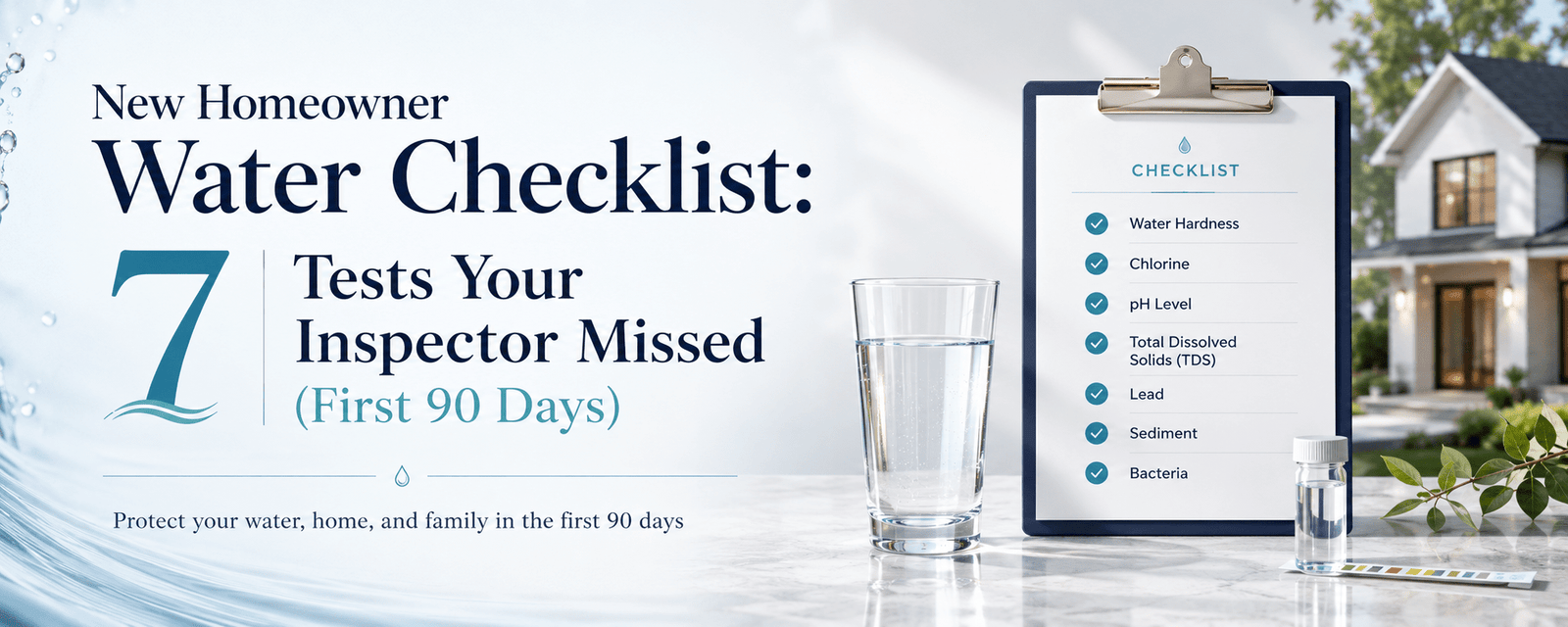
The 7 Critical Tests Your Inspector Might Have Missed
Before we get to the week-by-week plan, here are the seven most important water tests every new homeowner should understand:
Test 1: Bacterial Contamination (Coliform and E. coli)
Risk level: HIGH (immediate health threat)
Especially critical for: Well water users, older homes (pre-1950), homes near septic systems
Cost: $30-$50 per test
Frequency: Immediately upon move-in, then annually
Test 2: Lead Contamination
Risk level: HIGH (no safe level exists, especially for children)
Especially critical for: Homes built before 1986, homes with unknown service line material
Cost: $25-$150 depending on thoroughness
Detection: First-draw sample (water that sat in pipes overnight)
Test 3: PFAS (“Forever Chemicals”)
Risk level: HIGH (linked to cancer, immune dysfunction, developmental effects)
Especially critical for: Homes near military bases, airports, industrial facilities
Cost: $150-$400 for comprehensive PFAS panel
Detection: Must request PFAS specifically — standard tests don’t include it
Test 4: Water Hardness
Risk level: MODERATE (financial/appliance impact, skin issues)
Cost: $5 (DIY strip) to $50 (professional)
Impact: Above 7 GPG damages appliances and plumbing
Test 5: Heavy Metals Panel
Risk level: MODERATE to HIGH (chronic health effects)
Includes: Arsenic, copper, mercury, chromium, cadmium, nickel
Cost: $100-$200 for comprehensive panel
Especially critical for: Homes near industrial areas, private wells, areas with known groundwater contamination
Test 6: Nitrates
Risk level: CRITICAL for infants (methemoglobinemia/”blue baby syndrome”)
Cost: $25-$40
Especially critical for: Private wells, agricultural regions, homes with planned pregnancies or infants
Test 7: pH and Corrosion Indicators
Risk level: MODERATE (infrastructure damage, metal leaching)
Cost: $15-$25
Impact: Acidic water corrodes copper pipes, releasing copper into drinking water
The 90-Day Action Plan
Week 1 (Days 1-7): Immediate Assessment & Information Gathering
Day 1: Request Previous Owner’s Records
Any water quality test results from the sale inspection period
Water heater purchase/service history
Records of any water treatment equipment (softener, RO system, filters)
Municipal water bills showing any unusual charges (leak indicators)
Day 2-3: Review Your Municipal Water Report
Municipal water utilities must publish an annual Consumer Confidence Report (CCR)
Available on your utility’s website or at www.epa.gov/ccr
Pay attention to: violations, regulated contaminant levels, source of water, disinfection method
Day 4: Visual Plumbing Inspection
Walk through your home noting:
[ ] Pipe material (copper, galvanized, PEX, PVC)
[ ] Age of visible plumbing (green patina on copper = older)
[ ] Water heater age (check manufacture date sticker)
[ ] Any existing water treatment equipment
[ ] Visible mineral deposits on faucets and showerheads (hard water indicator)
[ ] Stained sinks, tubs, or toilets (iron, manganese, or hardness indicators)
[ ] Main water shutoff location (document for emergencies)
Day 5: Identify Water Source
Confirm whether you’re on:
Municipal water: Your utility tests regularly but not for all contaminants
Private well: You are responsible for all testing and treatment
Shared well: Community well serving multiple homes — check records
Surface water (rare): Lake, stream, or river source
Day 6-7: Initial Observations
Start noticing:
Water taste (chlorine, metallic, earthy, chemical)
Water odor (especially from hot water — indicates sulfur)
Water appearance (cloudy, yellow-tinged, particles)
How soap lathers (hard water indicator)
Skin feel after showering (dry/itchy = hardness or chlorine)
Any family member skin reactions in first days
End of Week 1 Deliverable:
You should know your water source, have your CCR reviewed (if municipal), have assessed visible plumbing condition, and have initial observations documented.
Week 2-4 (Days 8-30): Comprehensive Testing
Day 8: Certified Laboratory Mail-In Kit ($200-$600)
Companies: Tap Score/SimpleLab, CentralOhio Laboratories, NTL
Most comprehensive chemical analysis
Includes: bacteria, metals, VOCs, pesticides, PFAS
Results: 7-14 days
Best for: Complete peace of mind, well water users, concerns about specific contaminants
Option B: State/Local Health Department
Often free for basic bacterial testing
May cover nitrates in agricultural areas
Limited scope but free/low-cost baseline
Check your state health department website
Day 9-14: Collect and Submit Samples
For most accurate testing:
Use first-draw samples (water that’s been stagnant overnight) for lead
Use flushed samples for most other tests
Follow laboratory instructions precisely
Test cold water separately from hot water
Sample from multiple taps if issues suspected
Day 15-30: Await Results
During this period:
Continue observing water characteristics
Note any symptoms (skin issues, gastrointestinal complaints, unexplained headaches)
Research treatment options in parallel so you’re ready to act when results arrive
End of Weeks 2-4 Deliverable:
Comprehensive water quality data for your new home.
Week 5-8 (Days 31-60): Results Analysis & Solution Planning
Day 31-35: Analyze Test Results
When you receive results, rank issues by severity:
CRITICAL (Immediate Action Required):
Any detected coliform or E. coli bacteria
Lead above 15 ppb (EPA action level; 5 ppb is safer)
Nitrates above 10 ppm (especially if pregnant or with infants)
Arsenic above 10 ppb
Any detected hazardous VOCs
HIGH PRIORITY (Address Within 30 Days):
PFAS compounds detected (any level warrants action)
Water hardness exceeding 7 GPG
pH below 6.5 or above 8.5
Elevated iron or manganese (staining + taste issues)
Heavy metals at elevated but sub-action levels
MODERATE PRIORITY (Address Within 90 Days):
Chlorine/chloramine at high levels
TDS (total dissolved solids) over 500 ppm
Sulfur/hydrogen sulfide smell
Hardness 3.5-7 GPG (borderline, damages over time)
MONITORING (Address Opportunistically):
Mild aesthetic issues
Taste/odor preferences
Sub-threshold contaminant levels
Day 36-45: Research Solutions
Match problems to technologies:
| Problem | Best Solution | Typical Cost |
| Bacteria | UV disinfection or chlorination | $800-$1,500 |
| Lead | Certified lead filter + lead service line replacement | $500-$15,000 |
| PFAS | Catalytic carbon + specialized media or RO | $1,500-$8,000 |
| Hardness | Water softener or salt-free conditioner | $1,500-$3,500 |
| Iron/Manganese | Oxidation filter | $1,500-$3,500 |
| Acidity (low pH) | Acid neutralizer | $1,000-$2,000 |
| Chlorine/Chloramine | Carbon or catalytic carbon filter | $800-$2,500 |
| Multiple issues | All-in-one system | $4,500-$7,500 |
Day 46-55: Get Professional Consultations
For comprehensive solutions, schedule in-home consultations with:
- 2-3 reputable water treatment companies
- Compare proposed systems, warranties, and certifications
- Verify NSF certifications on proposed equipment
- Check Better Business Bureau and online reviews
- Ask for customer references in your area
Red flags during consultations:
- Pressure tactics or “today only” pricing
- Reluctance to provide written proposals
- Missing or incomplete certifications
- Vague answers about contaminant removal rates
- No transparent warranty documentation.
Day 56-60: Make Your Decision
Evaluate proposals based on:
- Does it address ALL prioritized contaminants from your test?
- Are removal rates verified by NSF certifications?
- Is it appropriately sized for your home (bedrooms × water usage)?
- Are installation, warranty, and maintenance clearly documented?
- Does it fit your budget including long-term maintenance?
- Does the company have a strong local service reputation?
End of Weeks 5-8 Deliverable:
Clear understanding of water issues, prioritized action plan, and selected solution.
Week 9-12 (Days 61-90): Installation & Establishing Maintenance
Day 61-65: Schedule Installation
Professional installation typically requires:
- 2-6 hours depending on system complexity
- Main water supply shutoff during installation
- Electrical access (some systems require outlet)
- Drain access (softeners, multi-stage systems)
Day 66: Installation Day
Ensure the installer:
- Reviews test results with you before installation
- Explains the system operation
- Sets up any timers, programming, or meter settings
- Demonstrates bypass valve operation
- Provides all warranty documentation
- Performs final water quality test after installation
Day 67-75: Initial System Break-In
In the first 1-2 weeks after installation:
- Check for any leaks at connection points daily
- Note water quality improvements (taste, smell, skin/hair feel)
- Test water hardness post-treatment to verify softener operation
- Run all fixtures for a few minutes to clear any sediment
Day 76-85: Establish Maintenance Schedule
Create a calendar with:
- Filter replacement dates (typically every 6-12 months)
- Salt refill schedule (for traditional softeners)
- Annual professional service date
- System warranty expiration tracking
- Anniversary retesting date
Day 86-90: Verification Retesting
Consider a post-installation water test to:
- Confirm treatment is working as specified
- Document baseline for future comparison
- Provide evidence for warranty claims if needed
- Create peace of mind
End of 90-Day Deliverable:
Properly installed water treatment, working system, established maintenance schedule, and post-treatment verification.
Special Considerations by Home Type
If You Bought a Newly Constructed Home (Built Last 5 Years)
Good news:
- Modern plumbing materials (PEX, copper) are generally lead-free
- Newer municipal connections in the area
- Usually no lead service lines
Pay attention to:
- Flushing new plumbing thoroughly (copper leaching during first year)
- Municipal water quality in rapidly growing areas (infrastructure catching up)
- PFAS contamination (affects new and old homes equally)
If You Bought a Pre-1986 Home
Higher risk factors:
- Possible lead service lines from street to home
- Lead solder in copper joints (banned after 1986)
- Galvanized pipes that have been corroding internally
- Older fixtures may contain lead
Essential tests:
- Lead first-draw and after-flush samples
- Copper levels (indicates pipe corrosion)
- pH (acidic water accelerates metal leaching)
Consider:
- Professional plumbing assessment
- Lead service line location inquiry with utility
- Possible service line replacement if lead confirmed
If You Bought a Home with a Private Well
Critical tests (beyond the standard seven):
- Arsenic (naturally occurring in many aquifers)
- Radon
- Pesticides/herbicides (if near agriculture)
- VOCs (if near industrial sites or gas stations)
- Hydrogen sulfide (rotten egg smell)
Unique considerations:
- You are the water utility — no backup testing
- Annual bacterial testing is essential
- Well inspection recommended every 5 years
- Know your well’s depth, location, and age
If You Inherited Existing Water Treatment Equipment
Don’t assume it’s working:
- Check media/filter age (may be expired)
- Verify system matches current water chemistry (may be undersized)
- Test water quality at the tap (easy way to confirm system effectiveness)
- Consider: Is it well-maintained, or has it been neglected?
- Get manufacturer/model information for future service
Why 90 Days Matters (The Cost of Delay)
Every day you delay addressing water quality issues in your new home, damage accumulates:
Bacterial contamination: Health risk exists with every consumption Lead exposure: Bioaccumulation in children is permanent — no safe level Hard water damage: Appliances degrade daily (water heater, dishwasher, washing machine) PFAS exposure: Accumulates in bloodstream with half-life of 5+ years Plumbing corrosion: Acidic or aggressive water damages pipes 24/7
The true cost of waiting 12 months vs. addressing in first 90 days:
| Issue | Cost of Delay (1 year) |
| Hard water appliance damage | $800-$1,500 in cumulative damage |
| Bottled water purchases | $1,000-$2,000 |
| Unnecessary soap/shampoo use | $200-$400 |
| Energy waste from scale | $115-$280 |
| Potential health impacts | Incalculable |
Contrast with resolution cost: $3,500-$7,500 one-time investment for comprehensive whole-home treatment that eliminates these issues for 10-15 years.
How Wellness Water Company Serves New Homeowners
Moving into a new home is overwhelming. The last thing you need is another complex decision to research from scratch. Wellness Water Company’s new homeowner program streamlines the entire process:
Step 1: Free Water Assessment Test
- Our Water Expert Will Connect With You For FREE Water Assessment Test Online.
- Tests for 15+ common contaminants and water quality indicators
- Checking all the parameters at the same time with you.
- No cost, no obligation
Step 2: Clear Explanation of Findings
- Technician explains what each result means
- Identifies which issues require action vs. monitoring
- Provides written documentation of test results
Step 3: Customized Solution Design
- Recommendations based on YOUR specific water and household
- Options ranging from targeted fixes to comprehensive all-in-one systems
- Transparent pricing with financing available
Step 4: Professional Installation
- Certified installers
- Typical installation in 1-3 days
- Minimal disruption to your move-in process
Step 5: Ongoing Support
- Scheduled filter delivery (never run out)
- Zero annual maintenance service charges
- Lifetime warranty
Schedule Your FREE Home Water Assessment Test Today.
New Homeowner Water Safety Checklist (Printable)
Week 1
- ☐ Review closing documents for any water-related disclosures
- ☐ Request previous owner’s water records
- ☐ Download your municipal Consumer Confidence Report
- ☐ Identify water source (municipal, well, other)
- ☐ Conduct visual plumbing inspection
- ☐ Locate and test main water shutoff valve
- ☐ Document initial observations
Weeks 2-4
- ☐ Schedule professional water testing
- ☐ Collect samples according to instructions
- ☐ Submit samples to certified lab or accept in-home testing
- ☐ Continue monitoring water characteristics
- ☐ Research treatment options preliminarily
Weeks 5-8
- ☐ Receive and review test results
- ☐ Rank issues by severity and health risk
- ☐ Research matching treatment technologies
- ☐ Schedule 2-3 professional consultations
- ☐ Compare proposals and company reputations
- ☐ Make solution selection
Weeks 9-12
- ☐ Schedule installation
- ☐ Prepare installation site (clear access, adequate power/drain)
- ☐ Supervise installation
- ☐ Receive system operation training
- ☐ File warranty documents
- ☐ Establish maintenance schedule
- ☐ Conduct post-installation verification test
Ongoing (Annually)
- ☐ Water quality retesting
- ☐ Filter/media replacement
- ☐ Professional system service
- ☐ Anode rod inspection (water heater)
- ☐ Emergency shutoff valve operation test
FAQs
Q: What water tests should I do after buying a house?
A: At minimum: bacterial testing (coliform/E. coli), lead, hardness, pH, and nitrates. For comprehensive protection, add: PFAS, heavy metals panel, and VOCs. Well water users should add: arsenic, radon, and pesticides if near agriculture. Budget $200-$600 for thorough professional testing.
Q: How soon should I test my water after moving in?
A: Within the first 30 days ideally. Water consumed between moving in and testing exposes your family to any contaminants present. Bacterial testing is most urgent (can occur within days). Comprehensive testing should happen in the first 4-6 weeks.
Q: How soon should I test my water after moving in?
A: Within the first 30 days ideally. Water consumed between moving in and testing exposes your family to any contaminants present. Bacterial testing is most urgent (can occur within days). Comprehensive testing should happen in the first 4-6 weeks.
Q: Is PFAS testing really necessary for my new home?
A: If your budget allows, yes. PFAS are in 45% of US tap water, are linked to serious health effects, and are not removed by standard filtration. They’re also not tested for in most inspections or standard testing panels. At $150-$400, PFAS testing provides critical health information that most homeowners never obtain.
Q: Do I need a water softener if I just moved to a hard water area?
A: Yes, if hardness exceeds 7 GPG. You’ll experience damage to your water heater, dishwasher, washing machine, and plumbing starting from day one. Skin and hair effects accumulate. Installing softening early prevents damage rather than mitigating it after the fact.