


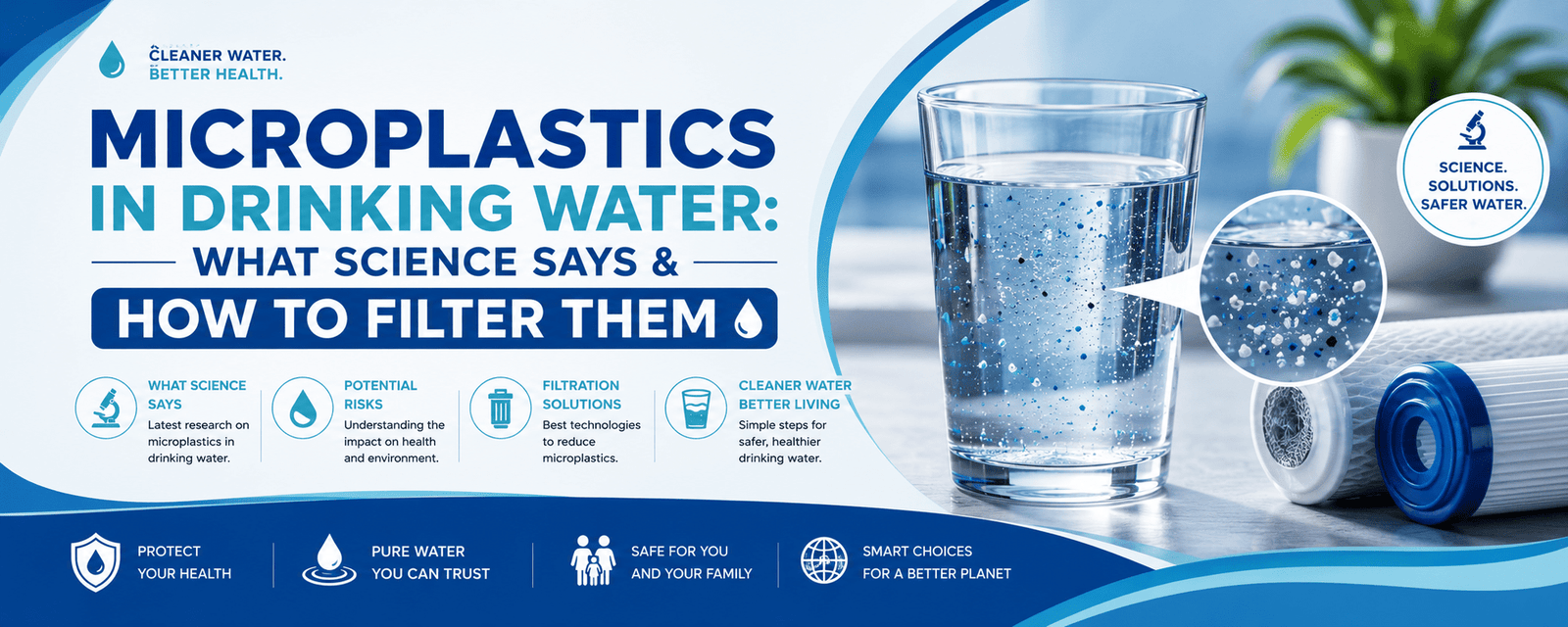
A few years ago, “microplastics” was a term most people associated with ocean documentaries and images of plastic pollution. Today, it has become a kitchen-table concern as researchers detect tiny plastic particles in water, food and the environment around us.
Microplastics in drinking water are now being studied in both tap and bottled supplies, raising two important questions for homeowners: what does the science actually tell us, and which water filtration technologies can help reduce them?
It’s easy to feel overwhelmed by alarming headlines. So instead of adding to the fear, this guide separates what researchers know from what remains uncertain—and focuses on one practical step homeowners can control: improving the quality of the water they drink.
Key Takeaways
- Microplastics are plastic particles smaller than 5 millimeters; nano-plastics are significantly smaller.
- Researchers have detected plastic particles in both tap and bottled water.
- A 2024 study found an average of approximately 240,000 detectable micro- and nanoplastic particles per liter in the bottled-water samples studied.
- Scientists are still investigating what long-term exposure means for human health.
- Water filtration can help reduce microplastics, but performance varies considerably between systems.
- Products with independently verified microplastics reduction claims provide greater assurance than filters relying only on general marketing claims.
- Reverse osmosis is an important technology to consider when reducing extremely small contaminants in drinking water.
What Are Microplastics and Nano-plastics?
Microplastics are generally defined as plastic particles smaller than five millimeters—roughly anything smaller than a sesame seed down to particles invisible to the naked eye. NOAA uses the less-than-5-millimeter definition for microplastics.
Nano-plastics are smaller still. Because they exist at the nanoscale, they are particularly difficult to detect, measure and study.
These particles can originate from many sources, including:
- Larger plastic products breaking down over time
- Synthetic clothing and textile fibers
- Tire wear
- Plastic packaging
- Industrial processes
- Bottles and food containers
- Environmental plastic pollution
As plastic products age and fragment, progressively smaller particles can move through soil, waterways and other parts of the environment.
That makes drinking water one potential pathway of human exposure—but not the only one.
How Do Microplastics Get Into Drinking Water?
Microplastics can reach drinking-water sources through environmental contamination.
Plastic waste slowly fragments outdoors. Synthetic fibers can enter wastewater when clothing is washed. Tire wear can contribute particles to road runoff. Plastic materials used throughout modern infrastructure and packaging may provide additional sources.
These particles can eventually reach rivers, reservoirs and groundwater used as drinking-water sources.
The extremely small size of some particles also makes studying them difficult. As detection technology improves, researchers are identifying particles that previous laboratory techniques may have missed.
That distinction is important: sometimes a dramatic increase in the number of particles reported by a study doesn’t necessarily mean contamination suddenly increased. It may mean scientists became better at detecting particles that were already there.
Microplastics in Bottled Water: What Research Found
Switching from tap water to bottled water might seem like an obvious solution when you’re worried about contaminants.
Research suggests the situation is more complicated.
A widely discussed 2024 study used an advanced imaging technique to examine bottled water and estimated an average of approximately 240,000 detectable plastic particles per liter, with around 90% classified as nano-plastics. The researchers detected roughly 10 to 100 times more plastic particles than earlier studies that primarily measured larger microplastics.
That’s an important finding—but it needs to be interpreted carefully.
It does not prove that every bottle of water contains 240,000 particles or that every bottled-water product contains more plastic particles than every municipal tap-water supply.
What it does show is that when researchers begin looking for much smaller particles with more advanced technology, they can find considerably more plastic than older testing methods revealed.
In other words, bottled water shouldn’t automatically be assumed to be a microplastic-free alternative to tap water.
Are Microplastics Harmful to Human Health?
This is the point where responsible science matters most.
Researchers have established that humans can be exposed to microplastics and nanoplastics through food, beverages and the surrounding environment.
What scientists have not yet established with certainty is exactly what typical levels of long-term exposure mean for human health.
Laboratory, animal and observational research continues to investigate questions involving inflammation, oxidative stress and other possible biological effects. However, identifying plastic particles in the human environment is not the same thing as proving that typical dietary exposure causes a particular disease.
The FDA currently states that the available scientific evidence does not demonstrate that the levels of microplastics or nanoplastics detected in foods pose a risk to human health, while also acknowledging that more research is needed and that significant knowledge gaps remain.
That distinction matters.
There is no reason to panic over a single glass of water. At the same time, homeowners who prefer to reduce unnecessary exposure can reasonably look at practical filtration options while the science continues to develop.
Are Microplastics Regulated in U.S. Drinking Water?
There is currently no federal drinking-water limit specifically regulating microplastics or nanoplastics in the United States.
However, federal attention to the issue is increasing.
In April 2026, the U.S. Environmental Protection Agency announced its draft Sixth Contaminant Candidate List (CCL 6). For the first time, microplastics were included as one of the contaminant groups being considered through this drinking-water evaluation process.
The Contaminant Candidate List identifies contaminants that are not currently subject to national primary drinking-water regulations but are known or anticipated to occur in public water systems and may warrant further evaluation.
Importantly, being included on CCL 6 does not mean EPA has established a legal drinking-water limit for microplastics.
It means the issue has entered a more formal federal research and evaluation pathway.
For homeowners, that’s another reason to follow emerging research rather than relying on outdated claims or assuming that “meeting current drinking-water standards” necessarily means a water supply has been evaluated against every emerging contaminant.
Can You Filter Microplastics Out of Drinking Water?
Yes, water filtration can help reduce microplastics—but not every filter should be assumed to perform equally.
Particle size, filtration technology, filter construction, flow rate, maintenance and independent testing can all affect real-world performance.
That means the better question isn’t simply:
“Does this filter remove microplastics?”
It’s:
“Has this specific filtration system been independently tested or certified for microplastics reduction?”
Some technologies worth evaluating include:
Reverse Osmosis
Reverse osmosis uses a very fine membrane as part of a multi-stage water-treatment process.
Because of its extremely fine filtration barrier, reverse osmosis is one of the most comprehensive home drinking-water treatment technologies to consider for reducing microplastics and other very small contaminants.
However, performance can vary by membrane, system design and maintenance.
Rather than assuming every reverse-osmosis system provides identical performance, review the manufacturer’s official performance data and independent certifications for the specific model you’re considering.
Fine Carbon-Block Filtration
High-quality carbon-block filters can combine adsorption with physical particle filtration.
Their ability to reduce microplastics depends partly on filter design and particle-retention characteristics. A generic carbon filter shouldn’t automatically be assumed to reduce every size of microplastic.
Carbon filtration can also be useful for addressing other water-quality concerns depending on the specific filter and its certified reduction claims.
Basic Pitcher and Refrigerator Filters
Performance varies widely.
A filter that improves chlorine taste or odor isn’t necessarily designed to reduce microplastics. Certification to one water-treatment standard also doesn’t automatically mean the product is certified for every contaminant covered by that standard.
Always check the specific reduction claims for the individual product.
How to Choose a Water Filter for Microplastics
When searching for the best water filter for microplastics, don’t rely solely on phrases such as:
“advanced filtration,”
“ultra clean,”
“premium purification,” or
“multi-stage filtration.”
Those descriptions sound impressive but don’t tell you what a product has actually been verified to reduce.
Look instead for independent testing and specific contaminant-reduction claims.
NSF explains that drinking-water treatment products certified under NSF/ANSI 401 with the appropriate microplastics reduction claim can be used to verify products evaluated for microplastics reduction. NSF also maintains a searchable database of certified drinking-water treatment products and their individual reduction claims.
This distinction is important:
Certified to a standard does not necessarily mean certified for every contaminant covered by that standard.
Check the actual certification listing or performance data sheet for the specific product.
When comparing filtration systems, consider:
- Independent certification
- Specific microplastics reduction claims
- Membrane or filter specifications
- Filter replacement frequency
- System flow rate
- Additional contaminants you want addressed
- Ongoing maintenance requirements
- Your household’s actual water quality
The right filtration system should be selected for your water—not simply because a particular technology is popular.
Does Reverse Osmosis Remove Microplastics?
Reverse osmosis is one of the leading technologies homeowners can consider when their goal is to reduce microplastics in drinking and cooking water.
RO systems force water through a very fine semipermeable membrane, providing a significantly finer physical barrier than many conventional filtration technologies.
However, extremely small nanoplastics remain an evolving area of scientific measurement. Researchers are still improving methods for detecting and quantifying the smallest particles, so claims that every nanoplastic particle is completely removed should be treated cautiously unless a specific product has reliable performance data supporting that statement.
For homeowners comparing systems, the safest approach is straightforward:
Look for documented filtration performance rather than absolute marketing promises.
Does Boiling Water Remove Microplastics?
Boiling should not be treated as a substitute for properly designed water filtration.
Some research has explored whether boiling can change the behavior of certain microplastic particles under specific water conditions, but results depend on factors such as mineral content, particle type and experimental conditions.
If your goal is dependable reduction, a water-treatment system designed and independently evaluated for particle reduction provides a more practical approach than relying on boiling alone.
Bottled Water Isn’t Automatically the Answer
When people become concerned about tap water, one of the fastest reactions is to start buying bottled water.
But bottled water isn’t automatically a microplastic-free solution.
As the 2024 nanoplastics research demonstrated, extremely small plastic particles can be present in bottled water too.
Bottled water also means purchasing, transporting, storing and disposing of containers again and again.
A properly selected home filtration system offers a different approach: treat the water where you use it and maintain control over the filtration equipment, filter replacement schedule and documented system performance.
For households that drink significant amounts of water every day, that can be a more practical long-term strategy than continually relying on disposable bottles.
Microplastics vs. Other Drinking-Water Contaminants
Microplastics are receiving significant attention, but they should not become the only thing homeowners think about when evaluating drinking water.
Depending on the home and water source, water-quality concerns may also include:
- Chlorine and chloramine
- Lead
- PFAS
- Arsenic
- Nitrates
- Sediment
- Hardness minerals
- Iron
- Manganese
- Volatile organic compounds
- Microbiological contaminants
That’s why choosing a water-treatment system based on one trending contaminant alone isn’t always the best approach.
A broader understanding of your water quality can help determine whether you need drinking-water filtration, whole-house filtration, water softening or a combination of treatment technologies.
Test First. Treat Second.
Water treatment works best when it starts with information.
Municipal water customers can begin by reviewing their local Consumer Confidence Report and available water-quality data. Private-well owners should consider appropriate laboratory testing based on their location, well conditions and potential contamination sources.
Testing can help identify which water-quality issues deserve attention before you invest in equipment.
From there, filtration can be selected around the actual needs of your household.
The principle is simple:
Understand what’s in your water. Choose treatment for what you find. Verify the performance of the system you install.
A Smarter Approach to Better Drinking Water
Microplastics are an emerging drinking-water concern, and the science will continue to evolve.
We already know that plastic particles can occur in our environment and drinking water. We also know that newer analytical technologies are detecting particles much smaller than researchers could reliably measure in the past.
What remains uncertain is exactly what different levels of lifelong exposure mean for human health.
That uncertainty doesn’t require panic.
It requires better information and smarter choices.
For homeowners who want to reduce microplastics and address other water-quality concerns at the same time, properly selected home filtration offers a practical way to take greater control of the water used for drinking and cooking.
Wellness Water Company provides advanced whole-home water filtration, water softening and drinking-water treatment solutions designed around a household’s specific water-quality needs. Explore our water filtration solutions or schedule a water assessment to better understand what’s flowing through your home.
Frequently Asked Questions
Are microplastics found in drinking water?
Yes. Researchers have detected microplastics in drinking-water sources, including tap and bottled water. Concentrations can vary considerably depending on the source, sampling method and laboratory technique used.
Are microplastics in bottled water?
Yes. Plastic particles have been detected in bottled water. A widely reported 2024 study estimated an average of approximately 240,000 detectable micro- and nanoplastic particles per liter in the bottled-water samples examined, around 90% of which were nanoplastics.
Is bottled water better than tap water for microplastics?
Not necessarily. Research has detected plastic particles in both. Available studies don’t justify assuming that every bottled-water product contains more—or less—microplastics than every tap-water supply.
Does reverse osmosis remove microplastics?
Reverse osmosis is one of the most comprehensive filtration technologies to consider for reducing microplastics because it uses an extremely fine membrane. Actual performance depends on the specific system, membrane, maintenance and verified reduction claims.
What is the best water filter for microplastics?
There isn’t one universal answer for every household. Look for a filtration system with independent testing or certification specifically supporting microplastics reduction. NSF/ANSI 401 includes a microplastics reduction claim that consumers can verify for individual certified products.
Do carbon filters remove microplastics?
Some fine carbon-block filtration systems may reduce microplastics through physical particle filtration, but performance varies. Check the specific system’s independently verified contaminant-reduction claims rather than assuming every carbon filter performs the same way.
Do pitcher filters remove microplastics?
Some may, while others may not. The answer depends on the individual filter and its verified performance. A general certification or claim about improving taste and odor does not automatically establish microplastics reduction.
Does boiling water remove microplastics?
Boiling should not be relied upon as a replacement for filtration designed to reduce particulate contaminants. Research into boiling and microplastics is still developing and results can depend on water chemistry and particle characteristics.
Are microplastics harmful?
Scientists are actively studying the potential health effects of microplastics and nanoplastics. Current FDA guidance says available evidence does not demonstrate that the levels detected in foods pose a human-health risk, but substantial research gaps remain.
Does the EPA regulate microplastics in drinking water?
There is currently no federal drinking-water limit specifically for microplastics. In April 2026, EPA included microplastics as a contaminant group on its draft Sixth Contaminant Candidate List, which supports further evaluation but does not itself establish a drinking-water standard.
How can I reduce microplastics in my drinking water?
Start by comparing filtration technologies with independently verified microplastics reduction performance. Reverse osmosis and products carrying appropriate microplastics reduction claims are strong options to investigate. Maintain filters according to manufacturer instructions because filtration performance depends on proper use and replacement.
Ready to Take More Control of Your Drinking Water?
Want to reduce microplastics and other unwanted substances in your drinking water?
Explore Wellness Water Company’s drinking-water and whole-home filtration solutions, or schedule a water assessment to identify the treatment approach that makes sense for your home.
Better water starts with knowing what you’re treating.