


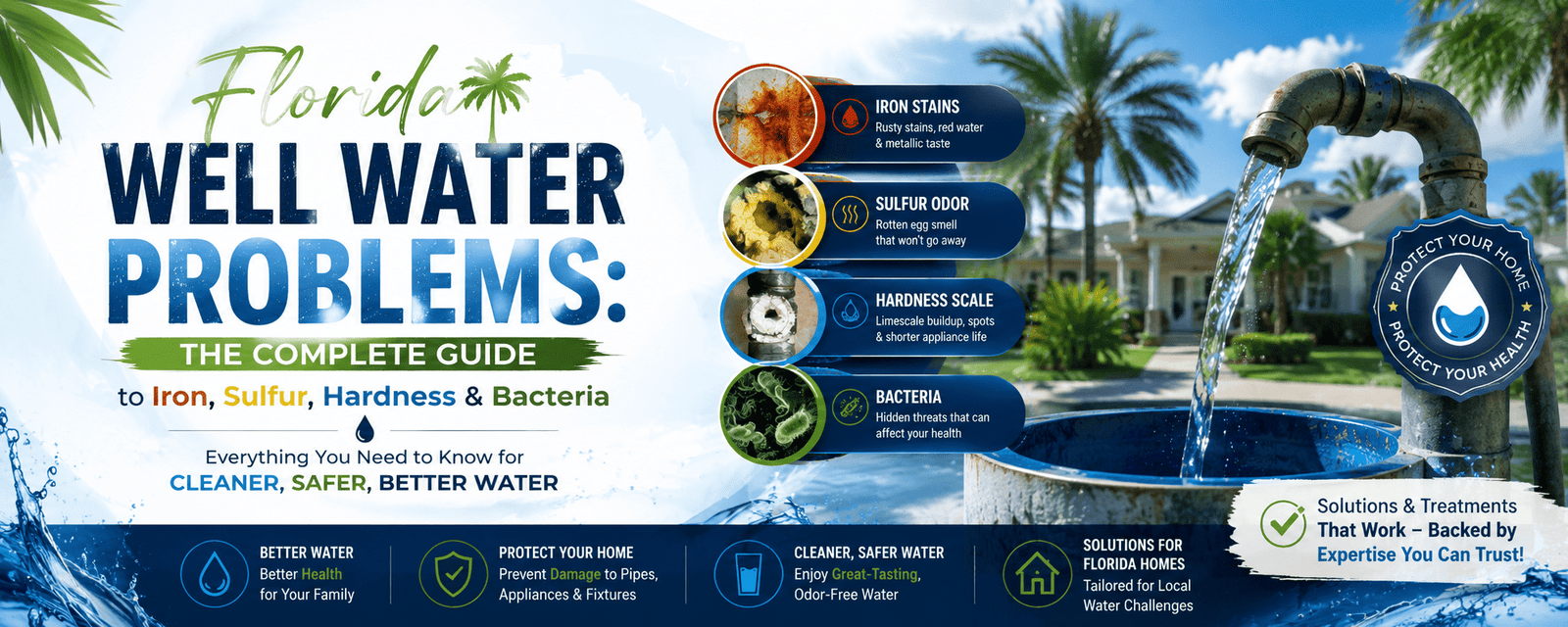
Florida sits atop one of the most complex hydrogeological formations in the United States. The Floridan Aquifer—a vast limestone system spanning over 100,000 square miles—supplies drinking water to approximately 10 million Floridians. For the estimated 2.5 million households relying on private wells, this geological blessing comes with a unique set of water quality challenges found nowhere else in the country.
If your Florida well water smells like rotten eggs, stains everything orange, leaves white scale on every surface, and occasionally tests positive for bacteria, you’re not alone. You’re experiencing the full Florida well water experience—and each problem has a specific, solvable cause rooted in the state’s unique geology.
The Sulfur Problem: Florida’s Signature Water Smell
That unmistakable rotten egg odor affects an estimated 40% of Florida well owners. The cause is hydrogen sulfide gas (H₂S), produced by sulfate-reducing bacteria that thrive in Florida’s warm, anaerobic aquifer conditions.
Why Florida is uniquely affected:
*The Floridan Aquifer contains naturally high sulfate levels from dissolved gypsum and anhydrite in the limestone
*Year-round warm groundwater temperatures (72-78°F) create ideal conditions for sulfate-reducing bacteria
*Low dissolved oxygen levels in deeper wells promote anaerobic bacterial activity.
Sulfur levels vary by depth and region:
*Shallow wells (under 100 feet): Often lower sulfur but higher bacteria risk
*Mid-depth wells (100-250 feet): Peak hydrogen sulfide zone in many areas
*Deep wells (250+ feet): May tap into sulfur-rich zones or bypass them entirely
Treatment approaches for Florida sulfur:
1. Aeration systems — Introduce oxygen to off-gas H₂S (effective up to 2-3 ppm)
2. Oxidation + filtration — Chlorine injection or ozone followed by catalytic carbon (handles 3-10+ ppm)
3. Air induction systems — Combine aeration and filtration in single-tank designs
4. Activated carbon — Only effective for very low levels (under 1 ppm)
The critical mistake Florida homeowners make is installing a basic carbon filter expecting it to handle serious sulfur problems. At concentrations above 1 ppm—common throughout Central and North Florida—oxidation-based treatment is essential.
Iron and Iron Bacteria: The Orange Stain Epidemic
Florida’s iron problems manifest in two forms: dissolved ferrous iron (clear water iron) and iron bacteria (that orange-brown slime in toilet tanks and well casings).
Dissolved iron enters well water as it passes through iron-bearing geological formations. Even 0.3 ppm—the EPA secondary standard—produces visible staining on fixtures, laundry, and surfaces.
Iron bacteria represent a more complex challenge unique to Florida’s climate. These organisms feed on dissolved iron and create biofilm colonies that:
– Clog well screens and reduce water flow
– Produce foul tastes and odors beyond typical sulfur
– Create orange/brown/reddish slime in plumbing fixtures
– Can harbor harmful bacteria within biofilm structures
Regional iron patterns:
*North Florida: Higher iron concentrations from red clay and iron-rich sand formations; 2-10+ ppm common
*Central Florida: Moderate iron with significant iron bacteria activity due to warm temperatures
*South Florida: Generally lower dissolved iron but Biscayne Aquifer areas can produce moderate levels
Treatment sequence for Florida iron:
1.Test for both dissolved iron AND iron bacteria (standard iron tests miss bacteria)
2. Shock chlorinate the well to address existing iron bacteria colonies
3. Install continuous chlorination or ozone for iron bacteria prevention
4. Follow with iron filtration media (Birm, Greensand Plus, or catalytic carbon)
5. Consider water softener as final polishing for residual low-level iron
Extreme Hardness:
Living on Limestone, Florida’s hardness levels rank among the highest in the nation. The state average exceeds 200 ppm (12 gpg), with many areas ranging from 250-400+ ppm (15-25+ gpg). This extreme hardness comes directly from dissolved calcium and magnesium carbonate as groundwater flows through the limestone aquifer.
Impact of Florida-level hardness:
– Water heater efficiency loss of 25-40% from scale buildup
– Appliance lifespan reduction of 30-50%
– Annual household cost increase of $800-$1,200 in soap, energy, and maintenance
– Pipe diameter reduction from internal scaling over time
Regional hardness variations:
*Southwest Florida (Lee, Collier counties): 250-400+ ppm — among the hardest in the state
*Central Florida (Polk, Osceola counties): 200-350 ppm
*North Florida (Alachua, Marion counties): 150-300 ppm
*Southeast Florida (Broward, Palm Beach): 150-250 ppm (Biscayne Aquifer generally softer)
Florida-specific softening considerations:
– Higher regeneration frequency needed due to extreme hardness levels
– Sizing must account for 15-25+ gpg rather than national average assumptions
– Salt-based ion exchange remains the only effective solution at these levels
– Consider high-efficiency systems to manage salt and water usage in environmentally sensitive areas
Bacterial Contamination: The High Water Table Threat
Florida’s uniquely high water table—sometimes just 2-5 feet below surface—creates contamination pathways that don’t exist in states with deeper aquifers. Combined with the state’s density of septic systems (approximately 2.6 million), the risk of bacterial contamination is significantly elevated.
Contamination risk factors:
*Septic system proximity: 1 in 3 Florida homes uses septic systems; required setbacks (75 feet) don’t always prevent contamination in porous limestone
*Flooding events: Hurricane season regularly introduces surface water into shallow wells
*Well construction defects: Older Florida wells may lack proper surface seals or grouting
*Karst geology: Sinkholes and limestone dissolution create direct surface-to-groundwater pathways
Testing protocol for Florida well owners:
– Total coliform and E. coli: Test annually minimum, after any flooding event
– Nitrates: Indicator of septic/fertilizer influence (test annually)
– Consider quarterly testing if within 200 feet of septic drain field
Treatment for bacterial issues:
– UV disinfection: Effective for consistent low-level coliform presence
– Continuous chlorination: Necessary when bacteria counts are high or intermittent
– Well rehabilitation: Required when contamination source is well construction deficiency
The Florida Treatment Sequence: Getting the Order Right
Florida well water typically requires multi-stage treatment. The sequence matters—installing components in the wrong order reduces effectiveness and shortens equipment life.
Recommended treatment order for comprehensive Florida well water:
1. Sediment pre-filter (5-20 micron) — Protect downstream equipment
2. Oxidation (chlorine injection, ozone, or air induction) — Address sulfur and iron bacteria
3. Contact tank — Allow oxidation time (20+ minutes for chlorine)
4. Iron/sulfur filtration (catalytic carbon or Greensand Plus) — Remove oxidized particles
5. Water softener — Address hardness after iron is removed
6. UV disinfection — Final bacterial safeguard
7. Reverse osmosis at point-of-use — Drinking water polishing
At Wellness Water Company, we understand that Florida well water isn’t like well water anywhere else in the country. Our water online assessment protocols are designed specifically for Florida’s unique geological challenges, and our treatment recommendations account for the regional variations that generic water treatment companies overlook. A water test that doesn’t account for iron bacteria, sulfate-reducing bacteria, and the specific mineral profile of your local aquifer zone is only telling half the story.
Frequently Asked Questions
Why does my Florida well water smell worse in summer?
Sulfate-reducing bacteria are more active in warmer temperatures. During summer, groundwater temperatures rise slightly, and the bacteria produce more hydrogen sulfide gas. Additionally, lower water tables during dry season can concentrate minerals and gases. This seasonal variation is normal and indicates biological sulfur production rather than a sudden contamination event.
How often should I test my Florida well water?
The Florida Department of Health recommends annual testing for bacteria and nitrates at minimum. However, given Florida’s unique challenges, we recommend comprehensive testing annually that includes iron (dissolved and total), hardness, sulfur, pH, and bacteria. Test immediately after any hurricane, flooding event, or if you notice changes in taste, odor, or appearance.
Can I drink Florida well water without treatment?
While some Florida wells produce water that meets all primary drinking water standards, the majority have at least one parameter—typically hardness, iron, or sulfur—that exceeds recommended levels. Even “safe” untreated Florida well water often contains levels of minerals that damage plumbing and reduce appliance life. A professional water test is the only way to know your specific situation.
Why is my Florida well water suddenly orange or brown?
Sudden color changes typically indicate iron bacteria bloom, well pump disturbance stirring sediment, or a change in aquifer conditions (often after heavy rainfall or drought). If the discoloration persists beyond 24 hours of running water, test for iron bacteria and total iron. A sudden change after a storm may indicate surface water intrusion requiring immediate bacterial testing.