


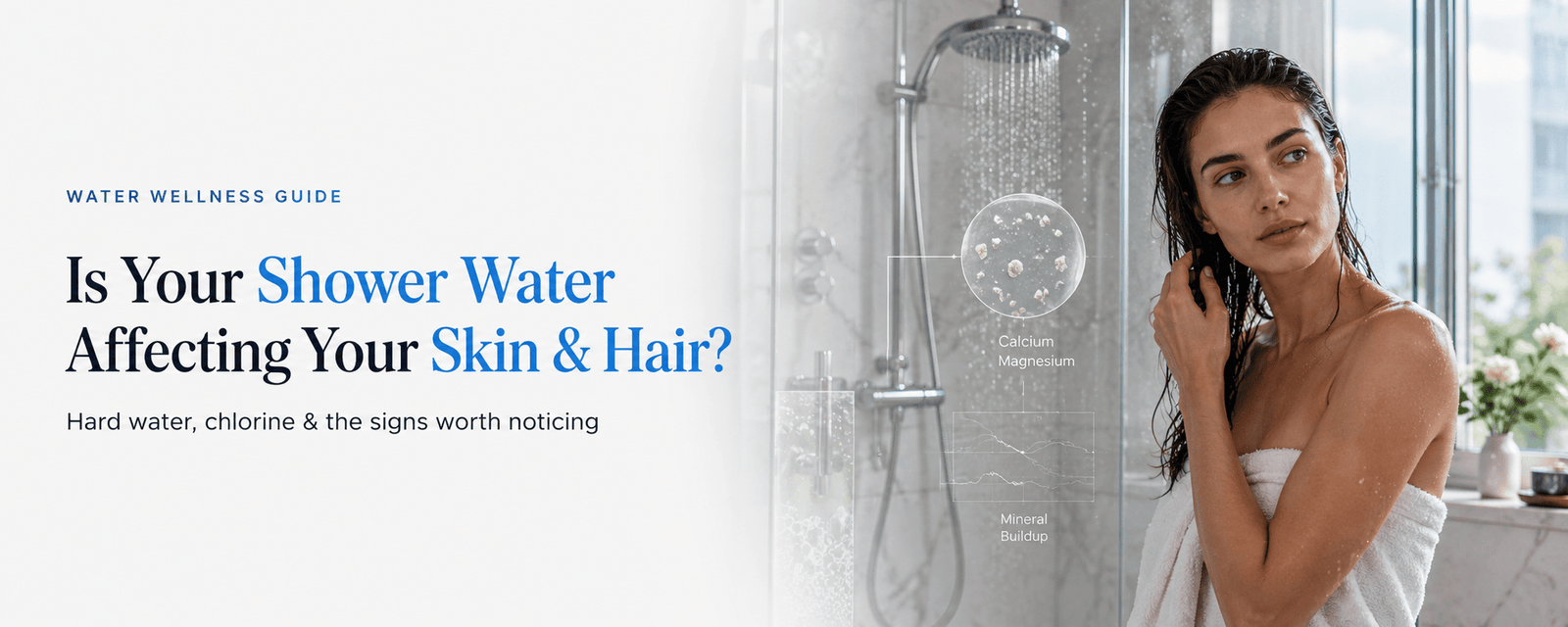
You can upgrade your shampoo. Change your moisturizer. Add another serum to the bathroom shelf.
But if your skin still feels tight after a shower—or your hair feels coated, dull or harder to manage—it may be worth looking at something that rarely makes it into the beauty routine:
the water itself.
The effects of hard water on skin and hair are easy to overlook because hard water usually looks perfectly clear. The difference is in what is dissolved in it, how those minerals interact with cleansers, and what gets left behind after the water disappears.
That does not mean every bad hair day or patch of dry skin is caused by your shower. Skin and hair are complicated, and products, weather, shower temperature and underlying conditions can all play a role.
But understanding your home’s water quality can help you stop guessing.
What Is Hard Water?
“Hard water often leaves clues throughout the home long before homeowners think about testing it. If scale, spotted glassware and stubborn mineral residue sound familiar, explore these common signs that your home may need a water softener and learn what hardness can look like beyond the shower.”
Hard water contains elevated levels of dissolved minerals, primarily calcium and magnesium.
These minerals enter water naturally as it moves through rock and soil before reaching a municipal supply or private well. Hardness is therefore not the same thing as contamination, and hard water can still meet drinking-water standards.
The problem homeowners usually notice is what those minerals do inside the home.
If you regularly see white scale around faucets, spots across glass shower doors, residue on fixtures or soap that seems difficult to rinse clean, mineral-rich water may be part of the reason.
And the same water is running through your shower every day.
How Hard Water Can Affect Your Skin
One of the more interesting connections between hard water and skin is not simply the minerals themselves.
It is what can happen when those minerals interact with soap and cleansing ingredients.
Research has found that washing with hard water can increase deposits of certain surfactants—the cleansing agents used in many soaps and body washes—on the skin. That residual material may contribute to irritation and greater disruption of the skin barrier in susceptible people.
In everyday terms, you may notice:
- Skin that feels tight after showering
- Soap that seems harder to rinse away
- A coated or filmy feeling
- Increased discomfort if your skin is already sensitive
- More reliance on moisturizer immediately after bathing
Hard water should not automatically be blamed for acne, eczema or another skin condition. Those are medical issues with multiple possible causes.
However, if your skin consistently feels different immediately after showering—and your home shows obvious signs of hardness—it is reasonable to investigate the water as one part of the picture.
Does Hard Water Affect Hair Too?
Hair can tell you quite a lot about the water you use.
Hard-water minerals can be deposited on the hair surface over repeated washing. Research has identified increased mineral deposition in hair exposed to hard water, although evidence that hard water directly causes major structural damage to healthy hair is less conclusive.
That distinction matters.
It is more responsible to say that mineral-rich water may change how hair feels, looks and responds to washing than to claim hard water automatically damages every person’s hair.
Homeowners commonly describe hair that feels:
- Dull or coated
- Less responsive to shampoo or conditioner
- More difficult to detangle
- Rough after rinsing
- Heavy despite being freshly washed
Color-treated, textured or naturally dry hair may make these changes more noticeable simply because those hair types already require careful moisture and product management.
Why Your Shampoo May Feel Different in Hard Water
There is another reason people sometimes assume their hair products have suddenly stopped working.
Hard water changes the washing experience.
Calcium and magnesium can interact with soap and some cleansing ingredients, reducing the easy lather and clean rinse homeowners expect.
So the reaction is often predictable:
More shampoo.
Excess body wash.
Extra conditioner.
More moisturizer afterward.
But using additional product does not necessarily address the water chemistry behind the experience.
That is why noticing persistent soap scum in the bathroom and persistent residue after washing can be useful clues. The two problems may be connected to the same underlying hardness.
What About Chlorine in Shower Water?
“Chlorine and chloramine serve an important purpose in municipal water treatment, but homeowners often want to understand what happens once that treated water reaches the house. Read our deeper guide to chlorine in tap water for a closer look at disinfection, household exposure and filtration considerations.”
Hardness is only one part of shower-water quality.
Many public water systems use chlorine or chloramine as disinfectants. These treatments serve an important public-health purpose by controlling harmful microorganisms as water travels through the distribution system.
EPA states that water containing regulated chloramine levels is considered safe for bathing and other normal household uses.
At the same time, some people—particularly those with sensitive or compromised skin—may notice that chlorinated water feels drying or irritating. Research involving people with atopic dermatitis has found that residual chlorine exposure can affect the water-holding capacity of the outer skin layer at certain concentrations.
The evidence is more nuanced than simply saying:
“Chlorine is ruining your skin.”
Your water chemistry, exposure, shower habits and individual skin barrier all matter.
Chlorine and Hard Water Are Different Problems
This is one of the most important things homeowners should understand before buying any water-treatment product.
Hardness primarily refers to minerals such as calcium and magnesium.
Chlorine and chloramine are disinfectants used in many municipal water supplies.
They are not the same problem—and they are not necessarily addressed by the same treatment technology.
A water softener is designed to address hardness.
A filtration system may be configured to reduce chlorine, sediment, odors or other specific substances depending on the media and system design.
That is why starting with the water itself is more useful than starting with a product.
Your Shower Temperature Matters Too
Here is the part that often gets lost in conversations about water quality:
Your water may not be acting alone.
Very hot, prolonged showers can contribute to skin dryness by disrupting surface lipids and increasing moisture loss. Strong cleansers, frequent shampooing, dry weather and some personal-care ingredients can add to the same experience.
So if your skin feels uncomfortable after showering, consider the complete routine:
How hot is the shower?
How long are you staying under it?
What cleanser are you using?
How often are you shampooing?
And what is actually in your water?
That is a much better diagnostic approach than assuming one variable explains everything.
What Role Does pH Play?
You may also hear a great deal about “pH-balanced” water and hair.
Skin naturally maintains a mildly acidic surface environment, while hair and scalp products are often formulated with pH in mind. Water pH can vary depending on the source and treatment process.
But pH should not be treated as a universal explanation for dry skin or difficult hair.
Hair condition is influenced by chemical treatments, heat, washing frequency, product formulation, mineral deposition and many other factors.
The practical takeaway is simple:
Water chemistry works as a system.
Hardness, disinfectant residuals, pH and other characteristics should be understood together—not reduced to one magic number.
How Can You Tell If Your Shower Water May Be Part of the Problem?
Before replacing your skincare routine, look around the bathroom.
Your fixtures often reveal water problems before your skin does.
Common signs associated with hard water include:
- White or chalky deposits around faucets
- Scale on the showerhead
- Persistent spotting on shower glass
- Soap scum that returns quickly
- Difficulty producing a satisfying lather
- Spots on dishes after washing
- Mineral buildup around fixtures
If several of these appear alongside hair that feels coated or skin that consistently feels tight after showering, testing your water is a sensible next step.
These signs are clues—not a medical diagnosis.
Test First. Treat Second.
A water-treatment system should solve your home’s water problem, not somebody else’s.
That is why water testing matters.
A hardness test can establish whether calcium and magnesium levels are actually elevated. If you’re on municipal water, your local utility’s water-quality report can also provide useful information about the source and treatment process.
Private wells require a different approach because water chemistry can vary significantly between properties.
Once you understand what is present, choosing the correct treatment becomes much easier.
This is also where a professional assessment can be valuable: hardness, chlorine, sediment, iron and other water characteristics may require different solutions.
Shower Filter vs. Whole-Home Water Treatment
A shower filter can be a convenient point-of-use option when your goal is to address certain substances specifically at one shower.
Depending on its media and certification, a shower filter may help reduce chlorine or certain aesthetic concerns.
But there is one important limitation:
Most conventional shower filters are not water softeners.
If calcium and magnesium hardness are causing scale throughout your home, treating one showerhead does not address the mineral-rich water flowing through the rest of the plumbing.
A whole-home approach treats water closer to the point where it enters the house. Depending on the system configuration, treatment can include filtration, softening or both.
The right choice depends on what your testing shows.
A shower filter may make sense when:
You want targeted treatment at a particular shower and your primary concern matches what that specific filter is designed and independently certified to reduce.
A whole-home system may make more sense when:
You are experiencing water-quality issues throughout the property—showers, fixtures, laundry, plumbing and water-using appliances—and want to address the incoming supply rather than one outlet.
It is less about which option is universally “better.”
It is about scope.
Why Softening and Filtration Should Not Be Confused
“Some homes need hardness treatment. Others need filtration. And some water conditions call for both. Explore our whole-house water filtration and softener system to understand how the two treatment approaches can be combined in one full-home strategy.”
Homeowners often use “water filter” and “water softener” as if they mean the same thing.
They do different jobs.
A traditional ion-exchange water softener targets hardness minerals such as calcium and magnesium. That can reduce the conditions that lead to scale and make hard-water cleaning problems easier to manage.
Filtration targets other water-quality concerns according to the filtration media being used.
For some homes, one treatment method may be enough.
For others, the right solution may combine technologies.
A properly designed system should be based on incoming water conditions, household demand, flow requirements and the specific issues the homeowner wants to address.

What Changes Might You Notice After Addressing Hard Water?
Everyone’s skin and hair respond differently.
What you can evaluate more objectively are changes in the water and household experience:
- Less hard-water scale
- Easier rinsing
- Reduced soap scum
- Different lathering behavior
- Fewer mineral spots on fixtures and glass
- Less mineral buildup around water-using surfaces
Some homeowners also report that their skin or hair feels different after the water is treated. Those experiences are personal and should not be presented as guaranteed medical or cosmetic outcomes.
It should not be taken directly as beauty treatment or sold like a beauty serum with guaranteed before-and-after results.
The first goal is better-matched water treatment.
The experience that follows is individual.
When Should You Speak to a Dermatologist?
Water quality is worth investigating—but it should never replace appropriate medical care.
Persistent itching, rashes, significant flaking, hair loss, inflamed skin or worsening eczema can have many causes.
If symptoms continue, speak with a qualified healthcare professional.
Treating hard water can address a household water-quality issue.
It is not a treatment for a medical condition.
Frequently Asked Questions
Can hard water make skin feel dry?
Hard water may contribute to a dry or tight feeling after washing, particularly because mineral-rich water can change how cleansers behave and increase surfactant residue on the skin. Individual responses vary, and other factors such as hot water, cleansers and underlying skin conditions can also contribute.
Can hard water damage hair?
Studies have found greater mineral deposition on hair exposed to hard water, but evidence that hard water automatically causes significant structural hair damage is limited. Many people instead notice differences in feel, buildup, shine or manageability.
Does hard water cause eczema?
It (hard water) should not be described as a direct cause of eczema. Research has found an association between hard-water exposure and atopic eczema risk, particularly in children, but studies of water softeners have not shown that softening water treats established eczema.
Does a shower filter soften hard water?
Most standard shower filters are designed for filtration rather than true water softening. Check exactly what a product is designed and independently certified to reduce before purchasing it.
How do I know whether I have hard water?
Scale around faucets and showerheads, spotting on glassware, persistent soap scum and difficulty lathering can all be clues. A water-hardness test provides a much more reliable answer.
Is chlorine in tap water unsafe for showering?
Chemicals like Chlorine and chloramine were and still widely used to disinfect public drinking water. Water that meets applicable EPA requirements is considered suitable for normal household uses, including bathing. Some people with sensitive skin may nevertheless notice irritation or dryness, which is why individual experience and water conditions matter.
Do I need filtration, softening or both?
It depends on your water. Softening targets hardness minerals, while filtration addresses specific substances depending on the treatment media. Testing first is the best way to determine what your home actually needs.
Better Shower Water Starts With Understanding Your Water
If you have been buying more products but still wondering why every shower leaves your skin feeling tight or your hair harder to manage, you do not need another guess.
You need better information.
Look for the clues around your home. Check your water source. Test the hardness. Understand whether chlorine or other water-quality concerns are relevant to your property.
Then choose treatment around the results.
At Wellness Water Company, we take a whole-home approach to water quality because the water you use does not stop at the kitchen faucet. It runs through your showers, laundry, fixtures and appliances every day.
A professional home water assessment can help identify what you are actually dealing with and which combination of filtration, conditioning or softening is appropriate for your household.
Start with your water. Then decide what it needs.