

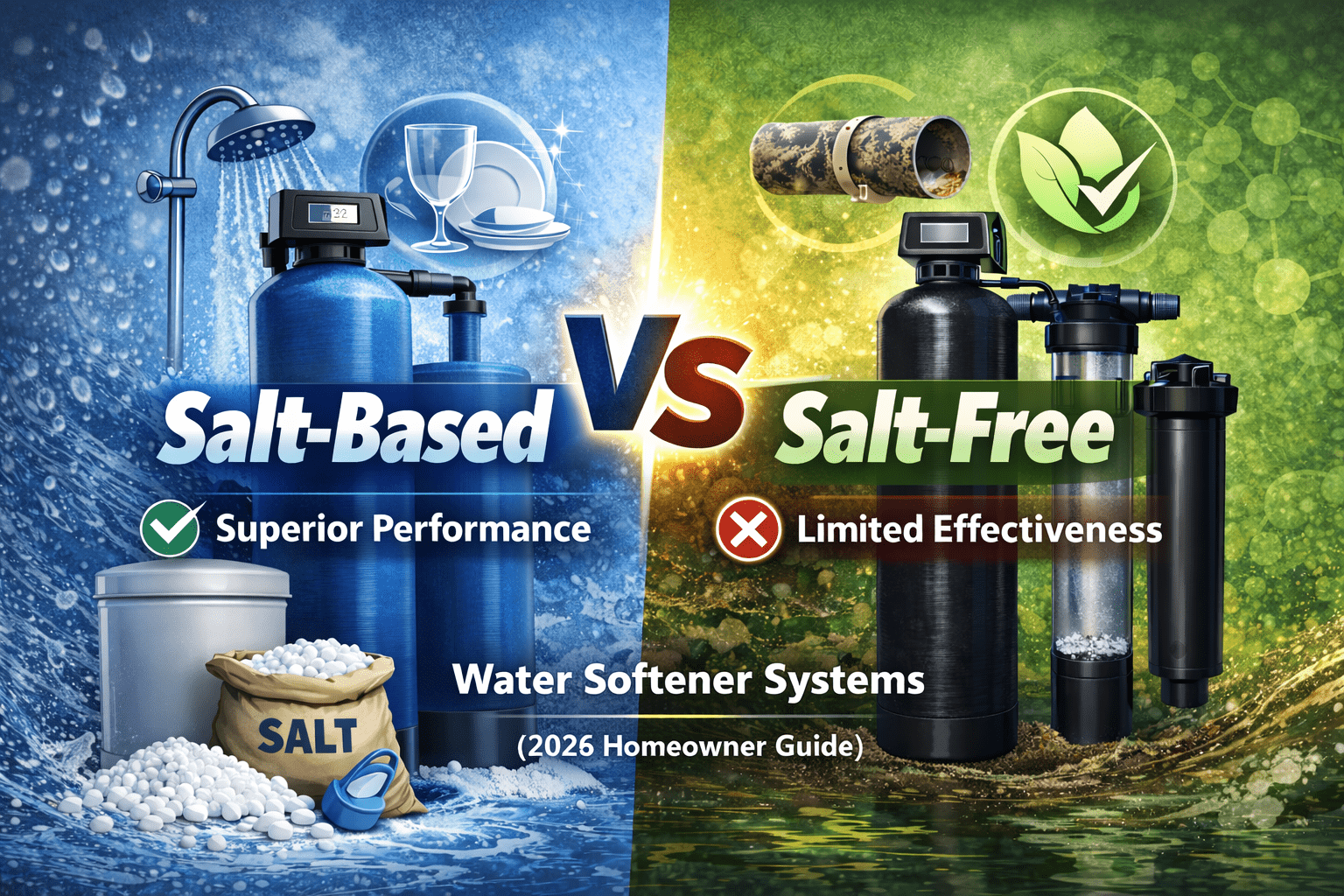
If you’ve been researching hard water solutions, you’ve probably noticed something confusing: “salt-free water softener” gets searched a lot, but most professionals still recommend salt-based water softeners for true soft water results. So what’s the real difference—and which one is best for your home?
This pillar guide breaks it down in plain language: how salt-based and salt-free water softener systems work, what they actually solve (and what they don’t), costs and maintenance, health/environment considerations, and how to choose the right option.
We’ll also explain why many homeowners ultimately choose salt-based softening—especially when they want real hardness removal, not just scale reduction.
Quick Definitions: “Softener” vs “Conditioner” (Why the Labels Matter)
Before comparing, it helps to know that the market often uses the word “softener” loosely.
Salt-based water softener (true softener): Removes hardness minerals (calcium and magnesium) from water.
Salt-free water softener (usually a conditioner): Does not remove hardness minerals. Instead, it reduces scale buildup by changing how minerals behave.
That’s why many “saltless water softener” or “salt free softener” products should technically be called water conditioners. They may help with scale, but they usually won’t deliver the same “soft water” feel.
What Is Hard Water and Why Should You Care?
Hard water contains high levels of calcium and magnesium. It’s not typically a health hazard, but it can create everyday problems:
Common hard water symptoms-
- White spots on dishes, glass, faucets, and shower doors
- Scale buildup in pipes and appliances
- Dry skin, dull hair, soap that won’t lather well
- Stiff laundry and faded fabrics
- Reduced water heater efficiency (scale acts like insulation)
If your main complaint is “my bathroom is always crusty” or “my water heater keeps failing,” you’re likely dealing with hardness—and that’s where choosing the right system matters.
How a Salt-Based Water Softener Works (Ion Exchange)
A salt-based water softener system uses a process called ion exchange:
- Hard water enters a resin tank filled with tiny beads.
- The beads are charged with sodium ions (or sometimes potassium).
- Calcium and magnesium stick to the resin.
- Sodium is released into the water in exchange.
- Periodically, the system regenerates by flushing brine through the resin, recharging it for the next cycle.
What salt-based softeners are best at-
- Actually removing hardness minerals
- Preventing scale in pipes and appliances
- Improving soap performance and “soft water feel”
- Reducing residue that makes bathrooms and kitchens harder to clean
“Does a salt softener add salt to the water?”
It adds a small amount of sodium depending on your hardness level. Most households consider it manageable, but if someone in your home must follow a strict low-sodium diet, consider discussing options with a professional (or your physician). Many families use softened water for bathing and general use and keep a dedicated drinking-water setup for taste preferences.
How Salt-Free Water Softeners Work (What They Actually Do)
Most salt-free water softener systems are one of these categories:
1) Template Assisted Crystallization (TAC) / “NAC”
This is the most common “real” salt-free conditioner technology. It changes dissolved hardness minerals into tiny crystals that are less likely to stick to surfaces.
What it helps: Scale reduction, less buildup in appliances and fixtures
What it doesn’t do: Remove hardness minerals from the water
2) Magnetic/Electronic “Descalers”
These systems claim to use electric or magnetic fields to reduce scale.
- Some homeowners report improvement; others see no change.
- Performance can vary widely depending on plumbing setup and hardness level.
3) Polyphosphate Feed Systems
Often used as “scale inhibitors” rather than whole-home solutions.
- More common in niche applications
- Not the same as true softening
Why “salt free water softener” is searched so much
Because it sounds like the perfect solution: no salt, no drain line, no regeneration, low maintenance. And for some homes—especially where scale control is the main goal—salt-free conditioners can be useful. But they’re not a 1:1 replacement for salt-based softeners when you want actual soft water.
Salt-Based vs Salt-Free: The Real-World Differences Homeowners Notice
If you want “soft water feel”
Choose salt-based.
- Soap lathers quickly
- Skin often feels less tight and dry
- Laundry feels softer
- Less shampoo use for many households
Salt-free systems typically won’t change the feel much because hardness minerals remain in the water.
If your main goal is reducing scale in plumbing/appliances.
Both can help, but in different ways:
Salt-based: removes hardness → less scale forms
Salt-free conditioner: alters mineral behavior → scale may form less aggressively or be easier to clean
If you hate maintenance and refills
Salt-free usually wins on convenience:
1. No salt bags
2. Often no drain line
3. Fewer service steps
But convenience isn’t the same as performance.
Performance Comparison: What Each System Solves Best
Salt-Based Water Softener (Best For)
- High hardness (especially very hard water)
- Visible scale buildup
- Appliance protection (water heater, dishwasher, washing machine)
- “Soft water” comfort and cleaning improvement
- Households that want the most proven hardness solution
Salt-Free Water Softener / Conditioner (Best For)
- Moderate hardness where scale control is the only goal
- Homes where discharge restrictions exist (some regions)
- People who strongly prefer to avoid salt handling
- Households willing to accept “conditioned” rather than truly softened water
Costs: Upfront Price vs Long-Term Ownership
Salt-based softener cost factors
- Equipment quality and size (grains capacity)
- Installation complexity
- Ongoing salt use
- Periodic servicing and checks
Salt-free water softener system cost factors
- Media replacement interval (varies)
- Upfront equipment cost (often comparable to softeners)
- Usually fewer ongoing consumables than salt
Important: A cheap system—salt-based or salt-free—can cost more later if it underperforms, breaks early, or doesn’t match your water chemistry.
Maintenance: What Homeowners Need to Know
Salt-based water softener maintenance
- Add salt as needed (frequency depends on use and hardness)
- Keep the brine tank clean
- Check settings and regeneration cycles
- Occasional inspection of valves/resin over time
Salt-based softeners are extremely common for a reason: they work reliably when sized and maintained properly.
Salt-free water softener maintenance
- Media cartridges often need replacement (interval depends on model and water conditions)
- Pre-filtration may be required if sediment is present
- Performance is more dependent on incoming water chemistry
Health, Taste, and Lifestyle Considerations
Sodium concerns (salt-based)
Softened water can contain added sodium. For most households this is not a major issue, but if you have:
- Strict sodium restrictions
- Certain health conditions (like advanced kidney disease)
then you should plan thoughtfully.
Many homeowners:
- Use softened water for the whole house (bathing, laundry, appliances)
- Use a separate drinking-water setup at the kitchen for preferred taste
Mineral content (salt-free)
Salt-free conditioners typically keep calcium and magnesium in the water. Some people like this from a “mineral water” perspective, but keep in mind: hardness minerals are not the same as a balanced dietary mineral intake.
Environmental and Plumbing Considerations
Salt-based softeners discharge brine during regeneration. In a few areas, local regulations limit softener discharge or encourage alternatives. If that applies to your city, you can still often find compliant options—just plan the right configuration.
Salt-free conditioners don’t regenerate with brine, which is why “salt free water softener” is attractive in regulation-heavy regions. But again: less discharge usually means less hardness removal.
Which One Should You Choose? A Simple Decision Guide
Choose a salt-based water softener system if:
- Your hardness is high or very high
- You want true softness (feel + cleaning + appliance protection)
- You’ve had recurring scale, plumbing, or water heater issues
- You want the most established, proven solution
Choose a salt-free water softener (conditioner) if:
- Your main goal is “less scale,” not “soft water”
- You want low-maintenance operation and no salt handling
- You live in an area where discharge restrictions influence your options
- You understand it won’t truly remove hardness minerals
How to Get It Right: Testing and Proper Sizing Matter More Than the Brand
This is where most homeowners waste money: they buy a system before they understand their water.
To choose correctly, you need:
- Hardness level (grains per gallon or mg/L)
- Water usage (household size)
- Iron/manganese presence (can affect performance)
- Sediment level (may require pre-treatment)
- Plumbing layout and drain access (for salt-based systems)
Wellness Water Company Tip
If you’re unsure what type of system you need, you can schedule a free water assessment with Wellness Water Company. It’s the fastest way to stop guessing and match the solution to your home’s actual water profile and goals (scale control vs true soft water).
Why We Promote Salt-Based Softeners (Even When “Salt Free” Gets More Searches)
It’s simple: performance.
A lot of people search “best salt free water softener” because they want an easy fix. But when homeowners truly want:
- softer skin/hair feel,
- better soap performance,
- real reduction of hardness-related damage,
- and maximum appliance protection,
Salt-based ion exchange softening is still the most proven method for whole-home hardness removal.
Salt-free systems can be helpful for scale management in specific situations, but they’re often not the best answer when your home is experiencing classic hard water problems.